Make "Waste," Not Haste
OR, Reflections on Efficacy, Efficiency & Ecosystem Development

“Who would look at the ground littered with cherry blossoms and complain, 'How inefficient and wasteful’!”
In their 2002 book Cradle to Cradle, William McDonough and Michael Braungart declare waste to be a design flaw, not an inevitability. In healthy ecosystems, waste equals food. However, in industrial and built systems, we try to minimize waste rather than reimagine it as an input.
"Everything," they write, "is a resource for something else."
"Consider the cherry tree: thousands of blossoms create fruit for birds, humans, and other animals, in order that one pit might eventually fall onto the ground, take root, and grow. Who would look at the ground littered with cherry blossoms and complain, 'How inefficient and wasteful!'
The tree makes copious blossoms and fruit without depleting its environment. Once they fall on the ground, their materials decompose and break down into nutrients that nourish microorganisms, insects, plants, animals, and soil."
I'm not sure if Bill and Mike have ever been to Northern Michigan, but they picked the perfect metaphor for our rural entrepreneurial ecosystem.
They remind us that excess effort, redundancy, and even failure serve a purpose—enriching the soil for others, supporting unseen players, or leading to unintended positive outcomes. Trying to optimize everything into a tight loop often stifles the generative potential ecosystems need.

Last year's Grove-hosted Northern Michigan Solidarity Economy shindig feat. leaders from around Michigan!
Separate But Equal(ly Connected)
I've had several recent conversations with colleagues who opined the need for consolidation in our local entrepreneurial ecosystem. “It’s too fragmented.” “Everyone is just doing their own thing.” "Shouldn't we just have a central authority for all this stuff."
One colleague asked if I though our two organizations wouldn’t be better off as a joint entity? I had to take a beat before answering. It was a fair question and deserved more than my typical flippant response.
I explained that, while I certainly appreciate efficiency and consolidation where it makes sense, I also see the value in distinct and purposeful organizations pursuing well-defined missions, alongside one another. Instead of combining, we should focus on strengthening the ties and interdependencies between all involved.
Often, we should opt for clarity and communication over consolidation, or even a surface-level veneer of kumbaya. Everything, even friction, is a resource for something else. The strands of a rope are held together by a little tension.
A long-suffering mentor once told me, "Look, the problem ain't that people work in silos. That's where some of the best work gets done. The problem's that none of the god damned silos bother talk'n to one another."
Some of the conversations I've had of late hit on a deep theme. Whether it's within an organization or across an ecosystem, I think smart, well-meaning people misunderstand the difference between efficiency and efficacy.
Efficiency is about doing things right: minimizing (or redirecting/ reinvesting) waste, maximizing throughput, optimizing for speed and cost. Efficacy, by contrast, is about doing the right things: achieving a desired effect, even if it takes longer, costs more, or resists standardization.
“Efficiency is about doing things right. Efficacy is about doing the right things.”
Properly defining the two isn't about semantics; the distinction sits at the heart of a philosophical and practical realignment needed in how we grow businesses, nurture founders, and invest in the soil of innovation.
So how do we take this highfalutin rhetoric and make it actionable. Aww, so glad you asked...
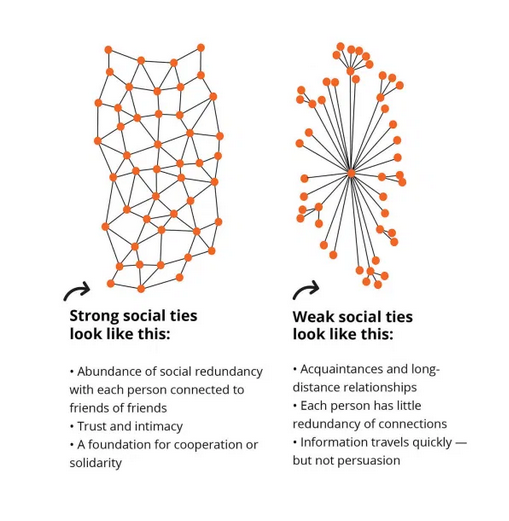
Checkout Damon Centola’s book Change: How Make Things Happen
Designing Principles: Building Efficacy w/ Integrity
So how do we design ecosystems that are efficacious, not just efficient? Here are a couple of emerging principles shamelessly poached (and slightly reworded) from systems thinkers and community builders like Donella Meadows, Brad Feld, Peter Block and others:
Prioritize relationships over transactions. Support networks built on trust, reciprocity, and shared values outlast transactional programming.
Measure what matters, not just what’s easy. Track founder wellbeing, community connectedness, and knowledge sharing—not just revenue or headcount.
Invest in stewards, not just startups. People who host, facilitate, and weave community--often behind the scenes--are the root system of a thriving ecosystem. Pay them, support them, and elevate their work. (*cough cough*)
Create regenerative structures. Borrowing from ecology, design programs that replenish rather than deplete—sharing power, redistributing capital, and returning value to the commons.
Make time your ally, not your enemy. Short-term wins are tempting, but ecosystems grow at the speed of trust. Orient toward decades, not quarters.
Stay curious. Efficacy requires continuous learning. As Victor Wang might suggest, build time for play, reflection, and adaptation into your ecosystem DNA.
Let form follow function. Don’t impose models from other cities or sectors. Design from the ground up, based on the needs, strengths, and aspirations of your local community.
--
A big disclaimer: none of this is intended to vilify the important work of efficiency. Instead, it's about shifting priorities and prioritizing when to shift. In his 2013 essay, Do Things That Don't Scale, Y Combinator founder Paul Graham writes about exactly that. He doesn't elevate one over the other. Rather, he talks about the importance of prioritizing efficacy early on before pivoting to efficiency if/when appropriate.
So, with all this in mind, we should take a note from McDonough, Braungart and the blossoming cherry trees of May: instead of going pedal to the metal, let's embrace more petals to the meadows.
Thanks for reading. Keep on growing!